





March 10, 2026 | Uncategorized
How Much Down Payment Do You Need to Buy a Home in Ontario?
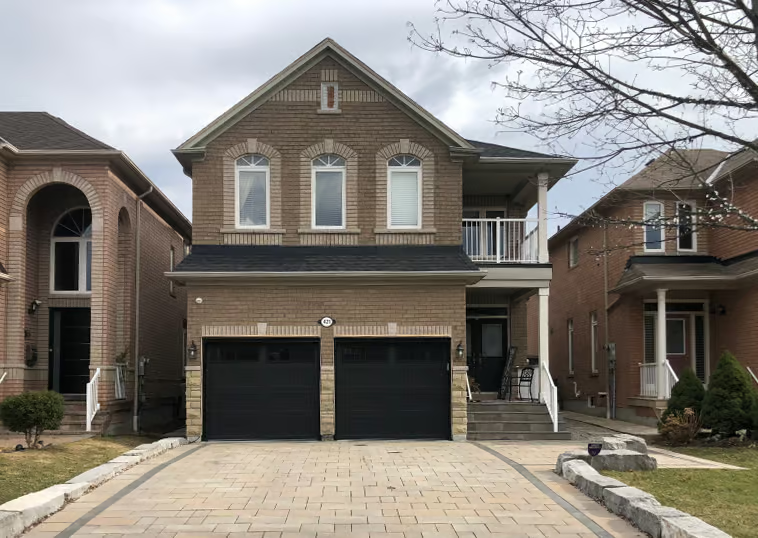
How Much Down Payment Do You Need to Buy a Home in Ontario? One of the most common questions home buyers in Ontario ask is: How much do I need for a down payment? The answer depends on the purchase price of the home you’re buying and your specific financial situation. This guide breaks down Ontario’s down payment requirements, explains your options, and outlines strategies to maximize your purchasing power as a buyer in 2026.
Minimum Down Payment Requirements in Canada
Canada’s minimum down payment rules are set federally and apply across Ontario:
For homes priced up to $500,000: The minimum down payment is 5% of the purchase price.
For homes priced between $500,000 and $999,999: The minimum is 5% on the first $500,000 ($25,000) plus 10% on the amount above $500,000. So for a $700,000 home, the minimum down payment would be $25,000 + $20,000 = $45,000 (6.43%).
For homes priced $1 million or more: The minimum down payment is 20% of the full purchase price. These properties are not eligible for CMHC mortgage insurance.
What Is Mortgage Default Insurance (CMHC)?
If your down payment is less than 20% of the purchase price, you’ll be required to purchase mortgage default insurance through CMHC (Canada Mortgage and Housing Corporation), Sagen (formerly Genworth), or Canada Guaranty. This insurance protects the lender — not you — in case you default on the mortgage.
Mortgage insurance premiums range from 2.80% to 4.00% of the mortgage amount depending on your down payment percentage. The premium is typically added to your mortgage balance, so you don’t need to pay it out of pocket upfront, but it does increase your total mortgage amount and monthly payments.
The premium rates are: 5% to 9.99% down payment = 4.00% premium; 10% to 14.99% down payment = 3.10% premium; 15% to 19.99% down payment = 2.80% premium. At 20% or more, no insurance is required.
Why a Larger Down Payment Makes Sense
While 5% is the minimum, putting more down has significant advantages. A larger down payment means: a smaller mortgage and lower monthly payments, no or lower mortgage insurance premiums, better mortgage interest rates (lenders reward lower loan-to-value ratios), more equity from day one, and greater financial security if property values fluctuate.
If you can save 20% or more, you avoid mortgage insurance entirely and gain access to the best mortgage rates available. In Ontario’s real estate market, where homes in Durham Region typically range from $600,000 to $900,000 for detached properties, a 20% down payment represents a meaningful savings target but one that many buyers can achieve with disciplined saving and the right government programs.
First-Time Buyer Programs to Help with Your Down Payment
First Home Savings Account (FHSA): Introduced in 2023, the FHSA allows first-time home buyers to contribute up to $8,000 per year (lifetime limit of $40,000) into a tax-sheltered account. Contributions are tax-deductible (like an RRSP), and withdrawals for a qualifying home purchase are completely tax-free (like a TFSA). This is one of the most powerful savings tools available to first-time buyers.
Home Buyers’ Plan (HBP): Allows you to withdraw up to $35,000 from your RRSP (per person, so $70,000 for a couple) tax-free to use towards your first home. The amount must be repaid to your RRSP over 15 years, with repayments starting two years after the withdrawal year.
Tax-Free Savings Account (TFSA): While not specifically designed for home buyers, many Canadians use their TFSA to save for a down payment, since growth and withdrawals are tax-free.
Down Payment Example: Durham Region Home
Let’s illustrate with an example. Suppose you’re buying a townhome in Ajax for $700,000. Your minimum down payment would be $45,000 (5% of $500K + 10% of $200K). At this level, you’d pay a CMHC insurance premium of 4.00% on the $655,000 mortgage, adding approximately $26,200 to your mortgage balance.
If instead you saved a 20% down payment of $140,000, you’d have no CMHC insurance, a mortgage of $560,000, and significantly lower total borrowing costs over the life of your mortgage.
Don’t Forget Closing Costs
Your down payment isn’t the only cash you’ll need. Closing costs — including land transfer tax, legal fees, title insurance, home inspection, and adjustments — typically add 1.5% to 4% of the purchase price. These must be paid from your own funds (they cannot be added to your mortgage). Budget for these costs separately from your down payment savings.
Final Thoughts
Understanding Ontario’s down payment requirements is a critical first step in your home-buying journey. With the right savings strategy and access to first-time buyer programs like the FHSA and HBP, reaching your down payment goal is very achievable. Team Rajpal works closely with buyers and trusted mortgage brokers to help you understand your options and make the most of your purchasing power. Contact us today to get started.

Have Questions?
Reach out to our experts! Whether you need help with a transaction or you’re just looking for market information, we’re here to help.