





April 20, 2026 | Selling
How to Price Your Home to Sell in Ontario: The Strategy Behind the Numbers
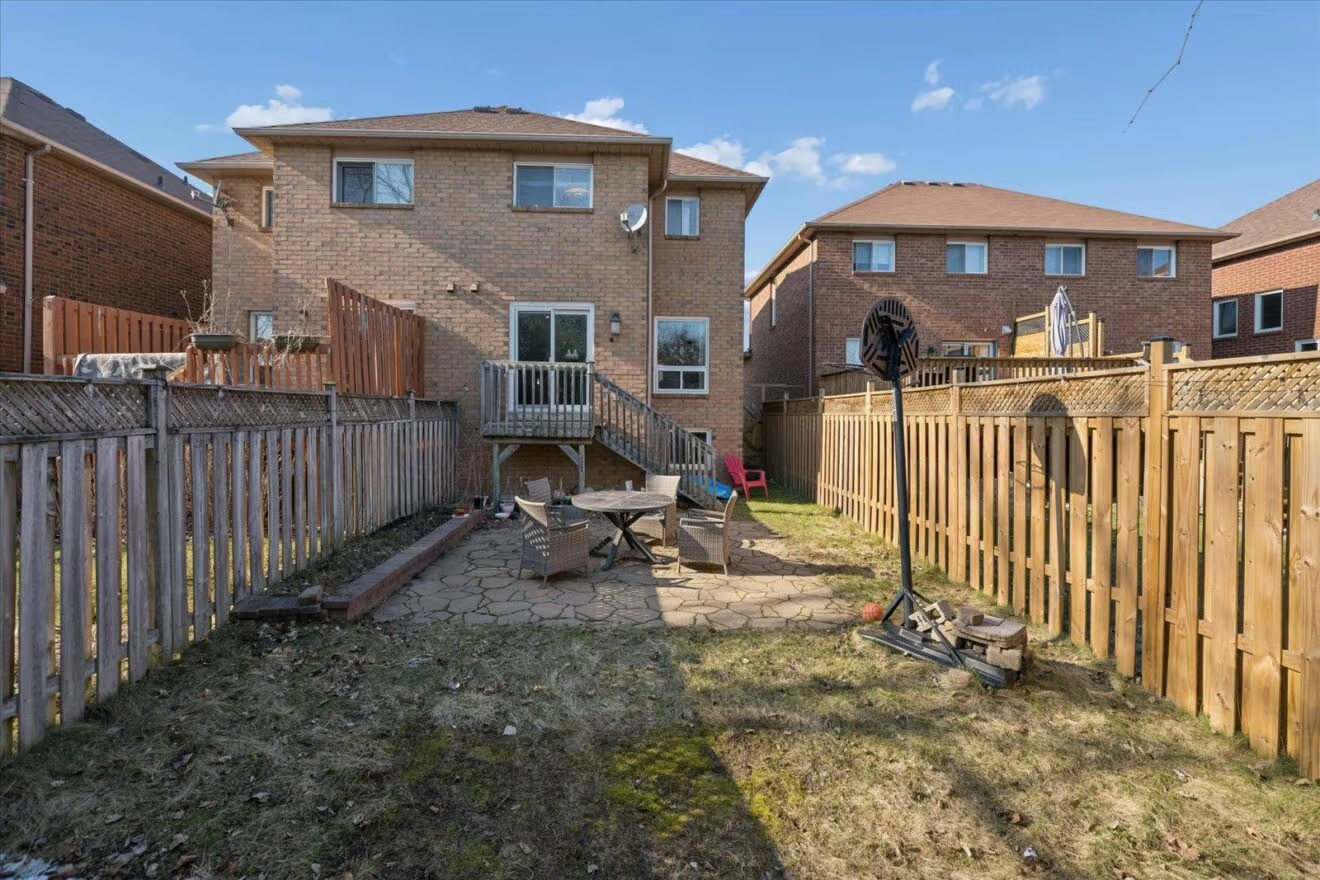
Knowing how to price your home to sell Ontario — and sell it well — Pricing your home correctly is arguably the single most important decision you’ll make when selling. In Ontario’s real estate market — which can shift from competitive bidding wars to slower, buyer-favoured conditions within the same year — pricing strategy requires more than just looking at what similar homes sold for. It requires understanding buyer psychology, market momentum, and the strategic levers that influence how quickly your home sells and for how much. Here’s what you need to know about how to price your home to sell in Ontario.
Why Pricing Strategy Matters More Than You Think
Many homeowners believe that overpricing leaves room to negotiate, or that the market will find the “right” price eventually. In reality, overpricing is one of the most costly mistakes a seller can make. Homes that are priced too high experience:
- Fewer showings in the critical first weeks on market
- A longer time on market, which signals problems to buyers even when there are none
- Price reductions that attract low offers and a stigma that’s hard to shake
- A final sale price that is often lower than if the home had been priced correctly from the beginning
The first two weeks a home is on the market are the most active period of buyer interest. Pricing too high wastes this critical window.
The Foundation: Comparative Market Analysis (CMA)
Every pricing decision should start with a thorough Comparative Market Analysis (CMA). A CMA looks at recently sold comparable properties (“comps”) in your area — homes similar in size, style, age, condition, and location to yours — and uses those sales as benchmarks for your pricing.
A professional CMA conducted by an experienced Ontario realtor goes beyond simply averaging comparable sale prices. It involves:
- Adjusting for differences between your home and comparables (square footage, lot size, upgrades, condition)
- Considering the direction of the market — are prices trending up or down?
- Looking at days on market for sold homes vs. homes that failed to sell
- Understanding the absorption rate — how quickly homes are selling in your price range
Understanding Market Conditions in Ontario
Ontario’s real estate market is not uniform — it varies by city, neighbourhood, property type, and price range. The pricing strategy that works in a seller’s market (low supply, high demand) is different from what’s effective in a balanced or buyer’s market. Understanding where your specific market sits is essential to pricing effectively.
Seller’s Market Pricing
In a seller’s market with limited inventory, pricing at or slightly below market value can generate multiple offers and drive the final sale price above asking. This “offer date” strategy — where you list below market, set an offer date, and review all offers on a specific day — is common in Ontario’s competitive markets and can produce exceptional results when executed well.
Balanced or Buyer’s Market Pricing
In a balanced or buyer’s market, pricing must be more precise. Buyers have options and will negotiate aggressively on overpriced homes or simply not show up. In these conditions, pricing at or just below fair market value generates the most activity and leads to the fastest, cleanest sale. Overpricing in a buyer’s market is particularly damaging because homes can sit unsold for months.
Price Brackets and Online Search Behaviour
One of the most practical but often overlooked aspects of pricing strategy is how buyers search online. Most buyers on MLS.ca, Realtor.ca, and other platforms use price range filters in increments of $25,000, $50,000, or $100,000. Pricing your home at the wrong spot in a price bracket can eliminate a large group of potential buyers.
For example, pricing at $999,999 appears in searches up to $1,000,000 and captures buyers with that maximum filter. Pricing at $1,010,000 might exclude everyone searching up to $1,000,000, significantly reducing your buyer pool. This isn’t always the right call, but it illustrates why pricing decisions deserve consideration of online search dynamics.
The Psychology of Pricing: What Buyers See
Buyers make snap judgments about homes the moment they see the listing price. A home priced at $849,000 sends a different signal than one priced at $875,000, even if both are within the same fair market value range. The lower price suggests the seller is motivated and realistic, while the higher price may feel like it leaves less room to negotiate even if that’s not the case.
Psychological pricing — using numbers that end in specific digits or sit just below major thresholds — is a real phenomenon in real estate, and experienced agents use it deliberately as part of their pricing strategy.
How to Price Your Home to Sell Ontario: Common Mistakes That Cost You Money
- Pricing based on what you need or want: The market doesn’t care what you paid or what you need to net. Price must be based on what buyers will pay.
- Ignoring days on market data: Unsold comparable listings are telling you the ceiling. Sold listings are telling you where buyers are transacting.
- Over-adjusting for renovations: You may have spent $80,000 renovating your kitchen, but buyers may only value that at $30,000-40,000 above comparable un-renovated homes.
- Refusing to reduce when the market signals you’re wrong: A rapid price reduction when the market signals overpricing is better than a slow decline followed by a much larger eventual reduction.
How Your Realtor Should Approach Pricing
A skilled Ontario realtor should present you with a comprehensive pricing analysis that includes: a range of comparable sales with adjustments, an absorption rate analysis, current active competition, and a recommended list price with a clear strategic rationale. Be wary of agents who simply tell you what you want to hear in order to win the listing — this practice, known as “buying a listing,” leads to disappointed sellers and lower final sale prices.
Final Thoughts
Pricing your home to sell in Ontario is part science, part art, and entirely strategic. The right price — set through proper analysis, deep market knowledge, and clear-eyed assessment of buyer behaviour — is the foundation of every successful home sale. When you price correctly, the market rewards you with more activity, faster offers, and better results.
Team Rajpal brings data-driven pricing expertise to every listing in the GTA and Durham Region. If you’re thinking about selling, contact us for a no-obligation home valuation and pricing strategy consultation.

Have Questions?
Reach out to our experts! Whether you need help with a transaction or you’re just looking for market information, we’re here to help.