





March 31, 2026 | Uncategorized
Can You Use Your RRSP to Buy a Second Home or Investment Property in Canada?
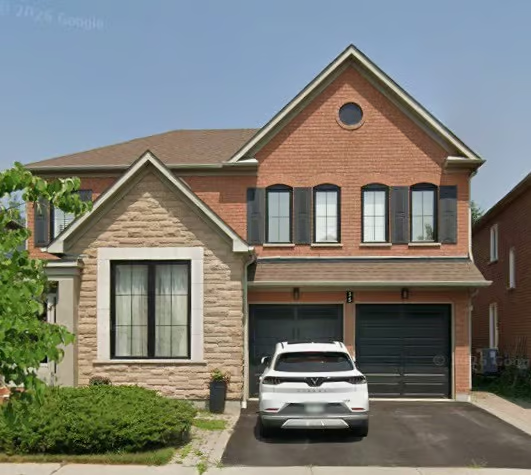
Many Canadians search for ways to use RRSP buy second home, investment property Canada — but the rules under the Home Buyers’ Plan are strict. RRSP buy second home or investment property in Canada is possible in limited circumstances — but understanding the rules helps you make smarter real estate decisions. The Registered Retirement Savings Plan (RRSP) Home Buyers’ Plan is one of the most well-known strategies for first-time homebuyers in Canada — but many people wonder whether they can use their RRSP to buy a second home or an investment property. The short answer is generally no, but there are important details, exceptions, and alternative strategies worth understanding.
This guide explains the RRSP Home Buyers’ Plan rules, who qualifies, and what options are available to Canadians looking to use their RRSP savings for real estate investment purposes.
What Is the RRSP Home Buyers’ Plan (HBP)?
The Home Buyers’ Plan (HBP) is a federal government program that allows eligible Canadians to withdraw up to $35,000 from their RRSP — tax-free — to purchase or build a qualifying home. If you have a spouse or common-law partner who also has an RRSP, they can withdraw an additional $35,000, for a combined total of $70,000.
The withdrawn amount must be repaid to your RRSP over a 15-year period. If you do not make the required annual repayments, the unpaid amount is added to your taxable income for that year.
Who Qualifies for the RRSP Home Buyers’ Plan?
To participate in the Home Buyers’ Plan, you must meet specific eligibility criteria. You must be a first-time homebuyer, which CRA defines as someone who has not owned and occupied a home as their principal place of residence at any time during the preceding four calendar years. You must have a written agreement to buy or build a qualifying home in Canada. You must intend to use the home as your principal place of residence within one year of buying or building it. Your RRSP contributions must have been in your account for at least 90 days before withdrawal.
RRSP Buy Second Home, Investment Property Canada: What the Rules Say
In most cases, no. The HBP is specifically designed for first-time homebuyers who intend to occupy the property as their principal residence. If you already own a home and want to buy a second property as a vacation home, investment property, or rental, the HBP does not apply.
However, there is one notable exception: if you qualify as a first-time homebuyer again. This can happen if you have not owned a home that you lived in as your principal residence during the four calendar years prior to the withdrawal year. For example, if you sold your home several years ago and have been renting since then, you may qualify again under the first-time buyer definition.
Can You Use Your RRSP to Buy an Investment Property in Canada?
This is one of the most common questions from real estate investors in Canada, and the answer is nuanced. You cannot use the RRSP Home Buyers’ Plan to withdraw funds to purchase a rental or investment property because the HBP requires the home to be your principal residence.
However, there are other ways to use RRSP funds for real estate investment, though they come with complexity and risk:
Option 1: Withdraw RRSP Funds and Pay Tax
You can always withdraw funds from your RRSP at any time — outside the HBP. However, withdrawals are fully taxable as income in the year you withdraw. If you withdraw $50,000 from your RRSP to use as a down payment on an investment property, that $50,000 is added to your income and taxed at your marginal rate.
For high-income earners, this could mean losing 40% to 50% of the withdrawal to taxes, which dramatically reduces the benefit. This strategy may make sense in a year where your income is unusually low, but it is generally not recommended purely for real estate investment purposes.
Option 2: RRSP Mortgage (Arm’s-Length Mortgage)
Under CRA rules, it is possible to hold a qualifying mortgage on a real estate property inside your RRSP — but the mortgage must be at arm’s length. This means your RRSP cannot hold a mortgage on a property you personally own or that is owned by someone with whom you do not deal at arm’s length (such as a close family member).
In practice, this strategy involves your RRSP acting as the lender on a third-party mortgage. The mortgage must be insured through CMHC and must be administered by an approved lender. This is a complex and expensive arrangement with limited practical application for most individual investors.
Option 3: Real Estate Investment Trusts (REITs) Inside Your RRSP
Publicly traded Real Estate Investment Trusts (REITs) are fully eligible RRSP investments. Holding REITs inside your RRSP gives you exposure to real estate returns without physically owning property. REITs hold portfolios of commercial, residential, industrial, or mixed-use properties and distribute a significant portion of their income as distributions.
This is the most straightforward and accessible way to use RRSP money for real estate investment in Canada. The income grows tax-sheltered inside your RRSP until withdrawal.
Option 4: Mortgage Investment Corporations (MICs) Inside Your RRSP
Mortgage Investment Corporations (MICs) pool investor funds to provide mortgages to borrowers. Qualifying MIC shares can be held inside an RRSP, TFSA, or RRIF. This allows your RRSP to earn mortgage interest income tax-sheltered. However, MIC investments carry liquidity risk and require careful due diligence before investing.
RRSP vs TFSA for Real Estate Investment in Canada
Many Canadian investors wonder whether the TFSA (Tax-Free Savings Account) offers better flexibility than the RRSP for real estate investment purposes. Like RRSPs, TFSAs can hold REITs, MIC shares, and other qualifying investments — but without the tax consequences on withdrawal. TFSA withdrawals are always tax-free, making TFSAs potentially more flexible than RRSPs for funding investment strategies.
However, the HBP-style program (Home Buyers’ Plan) currently applies only to RRSPs, not TFSAs (though the First Home Savings Account introduced in 2023 bridges some of this gap for first-time buyers).
The First Home Savings Account (FHSA) in Canada
As of 2023, Canada introduced the First Home Savings Account (FHSA), a new registered account that combines features of the RRSP and TFSA specifically for first-time homebuyers. Contributions are tax-deductible (like an RRSP), and withdrawals for a qualifying home purchase are tax-free (like a TFSA).
The FHSA does not apply to second homes or investment properties, and it can only be used for a first qualifying home purchase. However, understanding how the FHSA interacts with your RRSP Home Buyers’ Plan strategy is important if you are a first-time buyer considering your options.
Frequently Asked Questions
Can I use my RRSP to buy a vacation home in Canada?
No, not through the Home Buyers’ Plan. A vacation home does not qualify as a principal place of residence for HBP purposes. You could withdraw RRSP funds outside the HBP, but you would owe income tax on the full withdrawal amount.
Can I use the HBP if I owned a home years ago?
Possibly. If you have not owned and occupied a home as your principal residence in the four calendar years prior to the year of withdrawal, you may qualify as a first-time buyer under the CRA’s definition. This includes homeowners who sold their home several years ago and have been renting since.
What happens if I use HBP funds for an investment property?
If you withdraw funds under the HBP but then use them for an investment property rather than a qualifying principal residence, CRA will require you to add the withdrawal amount to your taxable income for that year, plus potential interest and penalties. It is critical to use HBP funds exactly as the rules require.
Final Thoughts
While using your RRSP to buy a second home or investment property in Canada is largely off the table under the Home Buyers’ Plan rules, there are legitimate strategies — such as REITs, MICs, and tax-managed RRSP withdrawals in low-income years — that allow your RRSP savings to contribute to a broader real estate investment strategy.
As always, major financial decisions involving registered accounts should be made in consultation with a qualified financial advisor and tax professional who understands your complete financial picture. If you have questions about buying real estate in Ontario, Team Rajpal is here to help you explore all your options.

Have Questions?
Reach out to our experts! Whether you need help with a transaction or you’re just looking for market information, we’re here to help.