




October 22, 2026 | Buying
Is It Cheaper to Rent or Buy a Home in Pickering and Ajax? (2026)
Updated October 2026 · By Xerxes Bharucha, Broker · Team Rajpal, Re/Max Key2 Real Estate., Brokerage, Seaton, Pickering
Quick answer: In Pickering, owning a condo apartment costs about the same each month as renting one. A typical condo apartment rents for about $2,300 a month, and the mortgage on a typical one is about $2,340. Townhouses cost more to own than to rent at first, but if you stay 4 to 5 years, buying usually puts you ahead. And if you only count the money you never get back (interest, tax and condo fees), owning a condo townhouse can cost less than renting one.
What does it cost to rent vs. own a home in Pickering?
Here’s what people paid in rent, and what the same kinds of homes sold for, in Pickering from April to September 2026.
| Type of home | Typical rent | Typical price | Typical mortgage payment* |
|---|---|---|---|
| Condo apartment | $2,300/month | $470,000 | about $2,340/month |
| Condo townhouse | $2,700/month | $606,500 | about $3,000/month |
| Freehold townhouse (no condo fees) | $3,050/month | $797,500 | about $3,900/month |
*For a first-time buyer with the smallest down payment allowed, paying the loan off over 30 years, at a 4.49% fixed rate. This is the mortgage only. Property tax, condo fees and repairs are extra. Source: home sales and rentals on TRREB’s MLS® system, April to September 2026.
In Ajax, freehold townhouses rented for about $3,000 a month and sold for about $750,000.
A real example: a 3-bedroom townhouse in Pickering
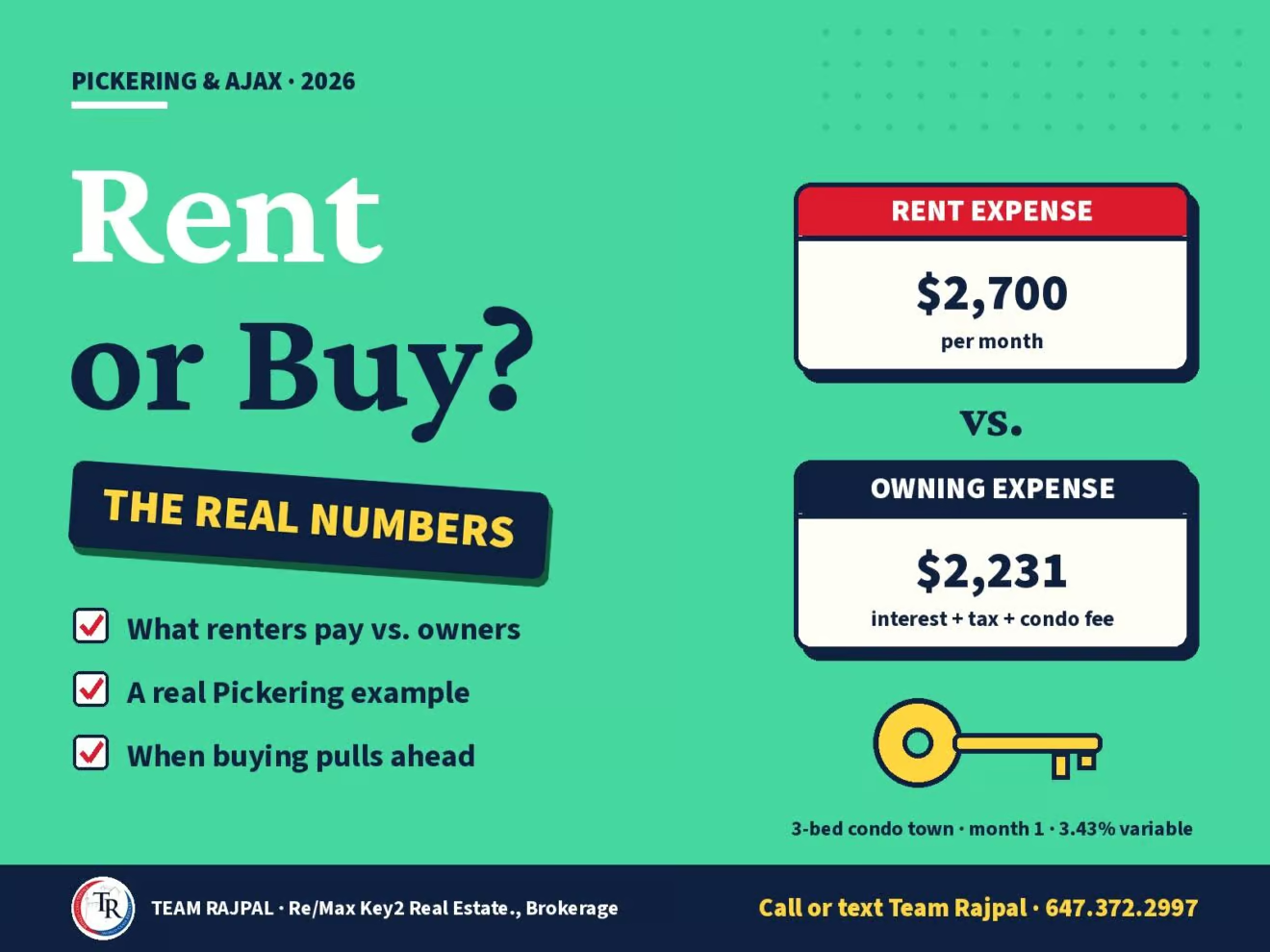
We ran one of our own listings through our Rent vs Own calculator: 1975 Rosefield Road #111, a 3-bedroom condo townhouse with a finished basement, listed at $549,000. Property tax is $3,852 a year, and the condo fee is $375 a month (it includes TV and internet). We compared it to paying $2,700 a month in rent, which is typical for a condo townhouse in Pickering.
| Variable rate (3.43%) | Fixed rate (4.49%) | |
|---|---|---|
| Mortgage payment | $2,400/month | $2,724/month |
| Total cost to own (mortgage, tax, condo fee, repairs, insurance) | $3,192/month | $3,516/month |
| How much more than renting | $467/month | $791/month |
| Owning expense: interest, property tax and condo fee (the money you don’t get back) | $2,231/month | $2,701/month |
| Part of the first payment that pays down your loan | $865 | $719 |
| When buying starts to win | After 4 years | After 5 years |
| How far ahead you are after 10 years | about $180,000 | about $115,000 |
| Cash you need on closing day | about $40,400 | about $40,400 |
What the two rates mean: a fixed rate stays the same for your whole 5-year term. A variable rate can go up or down with the Bank of Canada. The variable rate is lower today, but it can rise.
Rent expense vs. owning expense: rent is $2,700 a month, and all of it is gone once you pay it. To own at the variable rate, the interest is $1,535, property tax is $321 and the condo fee is $375. That’s $2,231 a month, about $470 less than renting. The other $865 of the mortgage payment pays down your loan. That money isn’t gone; it becomes part of the home you own.
This example assumes the buyer puts down the smallest amount allowed ($29,900), home prices rise 3% a year, rent rises 2.5% a year, and the renter invests the money they save each month.
Try it with your own numbers
Open the Rosefield example in our Rent vs Own calculator. Then make two changes so it matches a first-time buyer:


- Tap Advanced assumptions.
- Make sure I’m a first-time home buyer is ticked.
- Under Amortization (how many years you take to pay off the loan), choose 30 years.
The calculator guesses the tax and condo fee, so it will show about $3,210 a month instead of $3,192. Then change the price, rent and rate to match the home you’re looking at.
When is renting the better choice?
Renting still makes sense if:
- You might move in the next 3 or 4 years. Buying and selling a home both cost money, and it takes a few years to earn that back.
- You don’t have enough saved yet. On top of the down payment, you need money for land transfer tax, a lawyer and a home inspection.
- Your job or income is new or changing. The bank checks if you could still pay at a higher rate than the one you’ll get. A pre-approval tells you where you stand before you start looking.
How much money do you need to buy your first home in Pickering?
The smallest down payment allowed is 5% of the first $500,000 of the price, plus 10% of the rest. On the Rosefield townhouse, that’s $29,900. With land transfer tax and closing costs, you’d need about $40,400 in total. First-time buyers in Ontario get up to $4,000 of land transfer tax back.
You can save for your down payment without paying tax on it, using a First Home Savings Account (FHSA) or the Home Buyers’ Plan. Our first-time home buyer guide for Ontario explains both.
How do you time buying a home with your lease?
In Ontario, you must tell your landlord in writing at least 60 days before you move out, using a form called the N9. If you rent month to month, your move-out date must be the last day of a month. If you signed a lease for a set term, like one year, you usually can’t leave before it ends, unless your landlord agrees in writing or approves someone else taking over your lease (Landlord and Tenant Board).
Most home purchases close 30 to 90 days after your offer is accepted. So a simple plan is:
- Get pre-approved by a lender.
- Start looking 3 to 4 months before your lease ends.
- Give your landlord the N9 once your purchase is final.
What we see from our Seaton office
We see this all the time. A couple came into our office looking to rent in Pickering, with a budget of about $3,000 a month.
Step 1: We asked one question first. Had they ever checked whether they could buy instead? They hadn’t. Most renters we meet assume they can’t qualify for a mortgage, and many are wrong. We connected them with a mortgage broker, and they qualified for much more than they expected.
Step 2: We compared the real monthly cost. As renters, all $3,000 would go out the door every month, with nothing to show for it. Then we looked at what it would cost to own a condo townhouse, including property tax and the condo fee. Once we took out the part of the mortgage payment that pays down their loan (money that stays theirs), owning cost them about $400 less every month than renting.
Step 3: They got more home, with less work. Some of the condo townhouses we looked at were bigger than the rentals in their budget. And because it’s a condo townhouse, the condo fee covers much of the outside work, like grass cutting, snow removal and roof repairs, so there’s less to take care of than in a house.
The result: about $400 less a month in real costs, a bigger home, and a home of their own.
Our advice: before you sign or renew a lease, find out what you qualify for. It’s free, it takes about 15 minutes, and it might change your plans.
Find out what you qualify for, for free. We’ll connect you with a trusted mortgage broker who can tell you how much you could borrow, usually in one short call. There’s no cost and no pressure to buy. Call or text Team Rajpal · 647.372.2997 and ask for a mortgage broker introduction.
Team Rajpal
Rent vs buy in Pickering: FAQ
Is it cheaper to rent or buy in Pickering?
For a condo apartment, owning costs about the same each month as renting. For a townhouse, owning costs more each month at first, but if you stay 4 to 5 years, buying usually comes out ahead.
How much do I need to save to buy my first home in Pickering?
For a $549,000 townhouse, a first-time buyer needs about $29,900 for the down payment and about $40,400 in total once closing costs are added.
Can newcomers to Canada buy a home in Ontario?
Yes. Many lenders have programs for newcomers. You’ll usually need proof of income, a down payment and some credit history. Talk to a lender early to see what you qualify for.
What’s the difference between a fixed and a variable mortgage rate?
A fixed rate stays the same for your whole term, usually 5 years. A variable rate moves up or down with the Bank of Canada. Variable is lower today, but your payment could rise.
How much notice do I give my landlord when I buy a home in Ontario?
At least 60 days, in writing, using Form N9. If you’re on a one-year lease, you usually have to wait until the lease ends unless your landlord agrees.
Is it better to rent if I might move soon?
Often, yes. Buying and selling both have costs, so if you might move within 3 or 4 years, renting can be the better choice.
Talk to a local agent
Still renting in Pickering or Ajax? We’ll go through your numbers with you, connect you with a lender for a free pre-approval, and show you what your rent could be buying instead. Many of our first-time buyers are new to Canada, and we walk you through every step. Browse houses for sale in Pickering, or if you’re looking for a realtor in Pickering, start here.
Call or text Team Rajpal · 647.372.2997
Sources: rents and sale prices from TRREB MLS® leases and sales for Pickering and Ajax, April 1 – September 30, 2026, via The Habistat. Mortgage rates from Ratehub.ca, October 21, 2026. Example: Team Rajpal listing, 1975 Rosefield Rd #111, Pickering (MLS® E14088066).

Have Questions?
Reach out to our experts! Whether you need help with a transaction or you’re just looking for market information, we’re here to help.